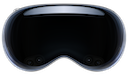
A glossary of terms related to Apple's mixed
reality
headset.
- Augmented Reality (AR)
- A technology that overlays digital information onto the real world,
enhancing one's
perception of reality using visual, auditory, or other sensory information.
- Computer Vision
- A field of artificial intelligence that trains computers to interpret
and understand
the visual world. It uses digital images and deep learning models to recognize
patterns and make
decisions.
- Depth Sensing
- A technology used in AR and MR to measure the distance to various
objects in the
environment, allowing for the creation of three-dimensional representations of the
surroundings.
- Eye Tracking
- The process of measuring either the point of gaze or the motion of an
eye relative to
the head, used in VR and AR to provide a more immersive experience.
- Gesture Recognition
- A technology in human-computer interaction that interprets human
gestures via
mathematical algorithms. Used in MR and VR to interact with digital or virtual
content.
- Haptic Feedback
- Technology that creates a tactile experience through vibrations or
motions, allowing
users to 'feel' virtual objects in AR and VR environments.
- Head Tracking
- A technology used in VR and AR headsets to monitor the user's head
movements and adjust
the virtual perspective accordingly, enhancing immersion.
- Immersive Technology
- Technologies that blur the line between the physical world and digital
or simulated
world, creating a sense of immersion. Includes AR, VR, and MR.
- Latency
- The delay before a transfer of data begins following an instruction. In
VR and AR,
lower latency is crucial for a more realistic and comfortable experience.
- LiDAR Scanner
- A technology used to measure distances by illuminating the target with
laser light and
measuring the reflection with a sensor, aiding in depth perception in AR
environments.
- Machine Learning
- A branch of artificial intelligence focused on building applications
that learn from
data and improve their accuracy over time without being programmed to do so.
- Motion Tracking
- The process of recording the movement of objects or people, used in AR
and VR for
replicating the movements in the virtual environment.
- Mixed Reality (MR)
- An advanced form of AR, mixed reality merges real and virtual worlds to
produce new
environments and visualizations where physical and digital objects co-exist and
interact in real
time.
- OLED Display
- Organic Light Emitting Diode display, known for high color accuracy,
deep blacks, and
reduced motion blur, used in high-end AR and VR headsets.
- Photonics
- The physical science of light (photon) generation, detection, and
manipulation through
emission, transmission, modulation, signal processing, and sensing.
- RealityOS
- A rumored operating system developed by Apple for its mixed reality
hardware, focusing
on immersive experiences and integration with existing Apple services.
- Retina Display
- A brand name used by Apple for its series of IPS LCD and OLED displays
that have a
higher pixel density than traditional Apple displays.
- Spatial Audio
- An audio technology that mimics the sound in a three-dimensional space,
enhancing the
immersive experience in AR and VR by providing depth and location of sounds.
- Spatial Computing
- A type of computing that uses the space around the user as a medium to
interact with
digital or virtual content, integral to AR and VR technologies.
- Telepresence
- The use of virtual reality and other interactive technologies allowing
a person to feel
or appear as if they are present in a place other than their true location.
- Virtual Reality (VR)
- A simulated experience that can be similar to or completely different
from the real
world, achieved through VR headsets and immersive technology.
- Voice Recognition
- A technology that enables a device to receive and interpret dictation,
or understand
and carry out spoken commands, often used in AR and VR interfaces.